Regulatory details below reflect the landscape as of April 2026; consult current EPA and state guidance for the latest requirements.
PTFE Woven Fabrics: Where They Perform Best and How to Specify Them for Your Application
Most engineers encounter PTFE fabric for the first time when a conventional material fails. A polyester filter bag dissolves after six months in a chemical processing line. A nylon conveyor belt degrades under continuous heat exposure. A polypropylene liner can't hold up to the pH extremes in a wastewater treatment system. The replacement spec almost always leads to PTFE.
Polytetrafluoroethylene, the fluoropolymer behind the Teflon trade name, has been used in industrial applications for decades, but woven PTFE fabric remains one of the least understood materials in the custom textile space. Engineers know PTFE is chemically inert and handles heat well. What they often don't know is how to specify a woven PTFE fabric for a unique application, what construction variables matter, and where PTFE is the right call versus an overengineered one.
This guide covers the performance characteristics that make PTFE woven fabric the material of choice for extreme environments, the applications where it consistently outperforms alternatives, and the decisions that determine whether a PTFE fabric delivers on its promise or falls short.
What Makes PTFE Woven Fabric Different
PTFE's performance profile starts with chemistry. The carbon-fluorine bond in polytetrafluoroethylene is one of the strongest single bonds in organic chemistry. That bond strength is what gives PTFE its signature combination of properties.
- near-universal chemical resistance
- a continuous operating temperature range up to 500°F (260°C)
- an extremely low coefficient of friction
- resistance to UV degradation
In woven form, those properties translate into a fabric that can operate in environments where most textiles simply cannot survive. Concentrated acids, caustic alkalis, organic solvents, oxidizing agents. PTFE is inert to nearly all of them. The exceptions are narrow (molten alkali metals, elemental fluorine at elevated temperatures, and a handful of exotic reagents that most industrial operations never encounter).
But chemistry alone doesn't make a fabric perform. Construction matters. A woven PTFE fabric's filtration efficiency, tensile strength, flexibility, and service life all depend on decisions made during engineering: yarn type (monofilament versus multifilament versus staple), thread count, weave pattern, and fabric weight. Two PTFE fabrics with the same fiber content can perform very differently depending on how they're constructed.
Where PTFE Woven Fabric Performs Best
Industrial Filtration
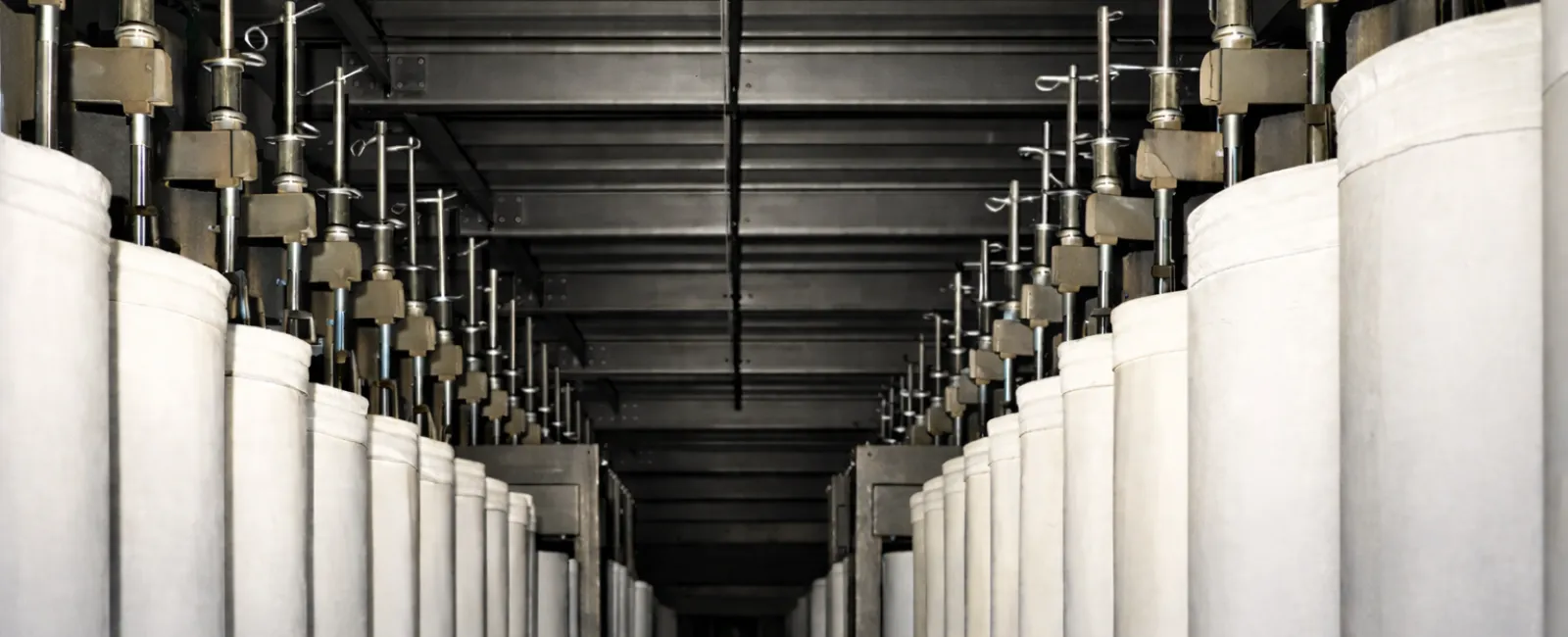
Filtration is the largest application category for woven PTFE fabrics and where the material's advantages are most measurable. In baghouse filtration systems for cement plants, power generation facilities, chemical processors, and waste incineration operations, PTFE filter bags routinely outlast polyester and polypropylene alternatives by a factor of three or more.
The reason is straightforward. PTFE's non-stick surface resists cake buildup. Particulate releases cleanly during pulse-jet cleaning cycles, which means lower pressure drop across the filter, reduced energy consumption, and longer intervals between bag replacements. In applications where the flue gas contains moisture, acid gases, or both, PTFE is often the only woven media that can maintain filtration efficiency without chemical degradation over time.
For liquid filtration, woven PTFE excels in applications involving aggressive chemicals. Pharmaceutical manufacturing, specialty chemical processing, and semiconductor fabrication all use PTFE filter media where fluid purity requirements are extreme and any fiber shedding or chemical leaching would contaminate the product.
Chemical Processing
Beyond filtration, PTFE woven fabrics serve as gasket materials, expansion joint covers, and liner fabrics in chemical processing environments. Any application where the fabric will contact concentrated acids, bases, or solvents at elevated temperatures is a candidate for PTFE. The material's dimensional stability under thermal cycling is a particular advantage in gasket applications, where expansion and contraction can compromise seal integrity with less stable materials.
Food and Pharmaceutical Manufacturing
PTFE's FDA-compliant grades make it suitable for direct food contact applications. Conveyor belting, release fabrics for baking and drying operations, and separator sheets in food processing all leverage PTFE's non-stick surface and thermal stability. In pharmaceutical applications, the same chemical inertness that makes PTFE work in industrial filtration makes it the preferred material for process filtration where product purity is non-negotiable.
High-Temperature Industrial Applications
In environments where continuous operating temperatures exceed 390°F (200°C), the field of viable woven materials narrows quickly. PTFE handles sustained exposure at temperatures that would degrade polyester (limited to roughly 300°F / 150°C), polypropylene (limited to roughly 195°F / 90°C), and nylon (limited to roughly 250°F / 120°C). For applications like thermal insulation wraps, heat shields in manufacturing equipment, and high-temperature conveyor systems, PTFE woven fabric provides a combination of thermal stability and mechanical flexibility that rigid materials cannot match.
How to Specify PTFE Woven Fabric
Getting the right performance from PTFE starts with specifying the right construction for the application. Here are the variables that matter most.
Yarn type. PTFE is available as monofilament yarn (a single continuous strand), multifilament yarn (many fine filaments twisted together), and staple yarn (short fibers spun into a yarn). Monofilament produces a fabric with a smoother surface and more consistent pore structure, making it the typical choice for precision filtration. Multifilament offers higher tensile strength and flexibility, which matters in applications involving repeated flexing or mechanical stress. Staple yarn creates a fabric with a textured surface and higher bulk, which can improve particle capture in certain filtration applications.
Weave pattern. Plain weave delivers the tightest construction and highest dimensional stability. Twill weave offers better drape and flexibility with slightly more open construction. Satin weave provides the smoothest surface and best release properties. The right pattern depends on whether the application prioritizes filtration efficiency, mechanical flexibility, surface release, or a balance of all three.
Fabric weight and thread count. Heavier fabrics (higher oz/sq yd or GSM) generally offer greater durability and longer service life but at the cost of flexibility and air permeability. Thread count affects pore size directly. Tighter thread counts produce finer filtration but also increase pressure drop. These tradeoffs are application-specific and should be engineered with the end-use environment in mind, not defaulted to a standard specification.
Finishing. PTFE woven fabrics can be heat-set for dimensional stability, calendered for surface smoothness, or sintered for enhanced strength at fiber crossover points. The finishing process can meaningfully change a fabric's performance characteristics, and the right finishing spec depends on the application's mechanical and thermal demands.
The PFAS Question: Where PTFE Stands
Engineers specifying PTFE in 2026 are asking a reasonable question. With PFAS regulations tightening at the federal and state level, is PTFE still a viable specification?
The short answer for most industrial applications is yes. PTFE is a fully polymerized fluoropolymer. While it belongs to the broad chemical family classified as PFAS (per- and polyfluoroalkyl substances), U.S. regulatory action has focused primarily on PFAS processing aids, precursors, and mobile or bioaccumulative compounds rather than finished fluoropolymers like PTFE. The EPA's current PFAS enforcement targets drinking water contaminants (PFOA and PFOS) and legacy manufacturing chemicals, not stable end-use polymers. Several states, including Washington and Maine, have passed PFAS product bans, but these focus on consumer goods and packaging. Industrial-use fluoropolymers like PTFE retain broad regulatory clearance for filtration, chemical processing, and high-temperature applications where no viable alternative exists.
That said, the regulatory landscape is evolving. Engineers should verify current regulations for their specific application and geography. For applications where PFAS-free alternatives are feasible, exploring those options makes sense. For applications where PTFE's chemical resistance, thermal stability, and longevity are genuinely required, the material remains the standard for good reason.
Working with a Custom PTFE Fabric Manufacturer
Off-the-shelf PTFE fabrics exist, but most high-performance applications require custom engineering. The width, weight, weave pattern, yarn type, and finishing spec all need to align with the application's specific demands. That means working with a manufacturer that can develop a custom construction, produce sample yardage for testing, and scale to production quantities once the specification is validated.
At Southern Industrial Fabrics, PTFE is one of many fiber types we weave in-house at our facility in Rossville, Georgia. Our engineering team works directly with customers to develop PTFE fabric specifications from the yarn level up, including rapid prototyping for applications where testing a sample before committing to a production run matters. Whether the application is filtration, chemical processing, thermal management, or something we haven't seen before, the process starts with a conversation about what the fabric needs to do.
If you have an application where conventional materials are falling short, or if you're evaluating PTFE for a new design, reach out to our team. We'll help you determine whether PTFE is the right fiber for the job and engineer the construction to match.