Polypropylene does not get the attention that aramid, polytetrafluoroethylene (PTFE), or carbon fiber received in industrial textile conversations. It is not exotic. It is not premium-priced.
For a wide range of industrial applications, that is exactly why it is the right fiber.
The challenge is knowing when polypropylene is the smart specification, and when its limits make a different fiber the better engineering choice.
What Makes Polypropylene Different from Other Industrial Fibers?
Polypropylene is a thermoplastic polymer with the lowest specific gravity of any common industrial fiber, meaning it produces lightweight fabrics that resist water absorption and chemical attack. Its cost is significantly lower than polyester or nylon, which makes it the default fiber for high-volume industrial applications that do not push extreme heat, ultraviolet (UV), or load-bearing requirements.
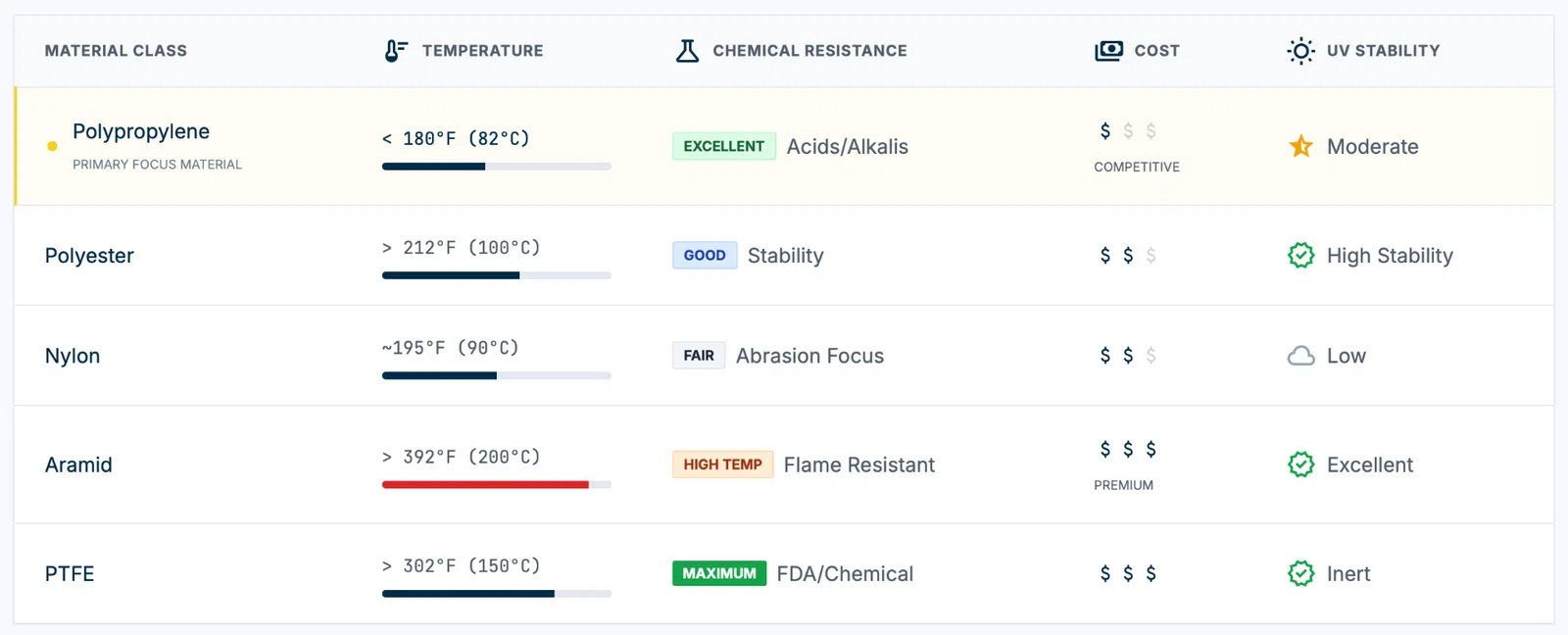
These properties determine where polypropylene replaces premium fibers and where premium fibers earn their cost over polypropylene:
- Low specific gravity. At 0.91 g/cm³, polypropylene is lighter than water. Polypropylene fabrics float and resist water saturation.
- Strong chemical resistance. Polypropylene resists most acids, bases, and salts at room temperature. It is one of the most chemically inert fibers available short of PTFE.
- Hydrophobic behavior. Polypropylene absorbs less than 0.1% moisture by weight. It does not lose strength in wet conditions.
- Continuous use temperature of approximately 212°F. Short-term exposure to 248°F is tolerable. Above that, polypropylene loses dimensional stability and begins to soften.
- Limited UV stability without additives. Untreated polypropylene degrades under sustained ultraviolet exposure. UV stabilizers can be added during fiber production for outdoor applications.
When Is Polypropylene the Right Fiber Choice?
Industrial Filtration at Moderate Temperatures
Polypropylene woven and nonwoven media handle aggressive chemical filtration at temperatures below 212°F. The hydrophobic surface releases filter cake cleanly, and the chemical resistance covers most acids, bases, and solvents encountered in chemical processing, food and beverage production, and pharmaceutical manufacturing.
Geotextile and Civil Construction
Polypropylene geotextiles deliver separation, filtration, and reinforcement in road construction, drainage systems, and erosion control. The low cost per square yard supports the volume requirements of infrastructure projects, and the chemical inertness extends service life across the 30-plus year design horizons typical of road and drainage construction.
Packaging and Bulk Handling
Woven polypropylene bags, flexible intermediate bulk containers, and industrial wraps carry 50 to 2,000 pounds of dry product in environments where moisture absorption would mean failure. Polypropylene packaging does not absorb water, mold, or degrade in storage.
Automotive Interiors and Components
Polypropylene fabrics are used in headliners, door panels, trunk liners, and underbody shields. Interior cabin temperatures during summer parking can exceed 160°F, which sits comfortably within polypropylene's thermal envelope, and the moldability supports the curved geometries that automotive interior parts require.
Marine and Outdoor Applications (with UV treatment)
UV-stabilized polypropylene fabrics serve in boat covers, outdoor furniture, and dock applications. A polypropylene line that breaks loose floats rather than sinks, which doubles as a safety feature in marine environments.
Each of these applications shares one structural fact: the operating environment stays within polypropylene's chemical and thermal envelope. When the environment exceeds that envelope, a different fiber is the correct call.
Polypropylene is the right fiber when the application calls for chemical resistance at moderate temperatures, lightweight construction, hydrophobic behavior, or cost-sensitive volume. Where these requirements align without exposing polypropylene's temperature or UV limits, it outperforms more expensive fibers on cost per yard of service life.
How Do You Specify a Custom Polypropylene Woven or Knit Fabric?
Questions that Drive Specification:
- What is the operating temperature range? Continuous and peak.
- What is the chemical exposure? Specific chemicals, concentrations, and pH levels.
- Is the application indoor or outdoor? If outdoor, UV stabilizer additives become part of the fiber specification.
- Is the fabric structural or non-structural? Load-bearing requirements drive yarn type and weave density.
- What dimensional or width requirements does the application have? Standard widths force seaming decisions; custom widths eliminate them.
- What production volume is the project? Prototype, small-batch, or full-scale production.
Standard polypropylene fabric exists for standard applications: bulk packaging, sediment bags, basic geotextile rolls. When the application introduces a non-standard width, a specific micron rating, a UV-stable formulation, or chemical compatibility outside stock product lines, custom engineering replaces catalog selection. The cost of that engineering is amortized across the service life of the resulting fabric.
Specifying custom polypropylene fabric starts with the application environment, performance targets, and production volume. From there, the engineering decisions include weave or knit construction, yarn type (monofilament, multifilament, or spun staple), weight per square yard, width, and any required UV or finishing treatments.
Why Does the Manufacturer Matter as Much as the Fiber?
The gap between a custom polypropylene fabric that performs and one that does not often shows up between vendors. When weaving, knitting, and finishing happen in separate facilities, every handoff introduces variability. Yarn tension at one site. Calendaring temperature at another. Finishing chemistry at a third. By the time the fabric reaches qualification testing, the construction approved on paper may not match what arrives in the warehouse.
At Southern Industrial Fabrics, custom polypropylene fabrics are engineered in-house at our Rossville, Georgia facility, from initial application discussion through prototype and production. The same loom that produces a 50-yard prototype produces the full production order. The specification approved at sample is the specification received at scale.
Most large textile mills will not take a polypropylene order under 500 yards. We will, because the engineering value of custom does not depend on volume. It depends on the match between the fabric and the application.
If you are sourcing polypropylene fabric for a new product, qualifying a replacement for media that is underperforming, or scoping a project that does not fit standard product lines, send us the application requirements. We will recommend a polypropylene construction, or tell you honestly that polyester, nylon, aramid, or PTFE would serve you better.
Frequently Asked Questions
What is polypropylene fabric used for in industrial applications?
Polypropylene fabric is used in industrial applications where moisture resistance, chemical resistance, and low cost matter more than high-temperature performance. Common categories include filtration media for chemical processes below 212°F, geotextiles for civil construction and erosion control, packaging for bulk and industrial handling, and lightweight interior components in automotive and marine markets.
What temperature can polypropylene fabric withstand?
Polypropylene fabric handles continuous operating temperatures up to approximately 212°F with short-term peaks to 248°F. Above 248°F, polypropylene loses dimensional stability and begins to soften. Applications above this range require polyester, aramid, or PTFE instead.
Is polypropylene fabric chemical resistant?
Yes. Polypropylene resists most acids, bases, salts, and many solvents at room temperature, making it one of the most chemically inert industrial fibers available short of PTFE. Chlorinated hydrocarbons can cause swelling at room temperature and dissolve polypropylene at 160°F and above.
Is polypropylene better than polyester for industrial fabric?
Polypropylene is better than polyester when chemical resistance, hydrophobic behavior, and low cost are the priorities. Polyester is better than polypropylene when UV stability, higher operating temperatures, or sustained load-bearing performance are required. The right fiber depends on the application environment.
Is polypropylene UV resistant?
Untreated polypropylene fabric degrades under sustained ultraviolet exposure and is not recommended for long-term outdoor use without modification. UV stabilizers can be added during fiber production to extend service life in outdoor applications, but UV-stable polyester is often the smarter specification for outdoor environments.
What is the difference between woven and nonwoven polypropylene fabric?
Woven polypropylene fabric is constructed from interlaced yarns and offers higher tensile strength, dimensional stability, and structural integrity. Nonwoven polypropylene fabric is bonded from fibers without weaving and offers higher porosity, lower cost, and faster production. Woven is the right choice for structural reinforcement; nonwoven is the right choice for high-porosity filtration or single-use applications.