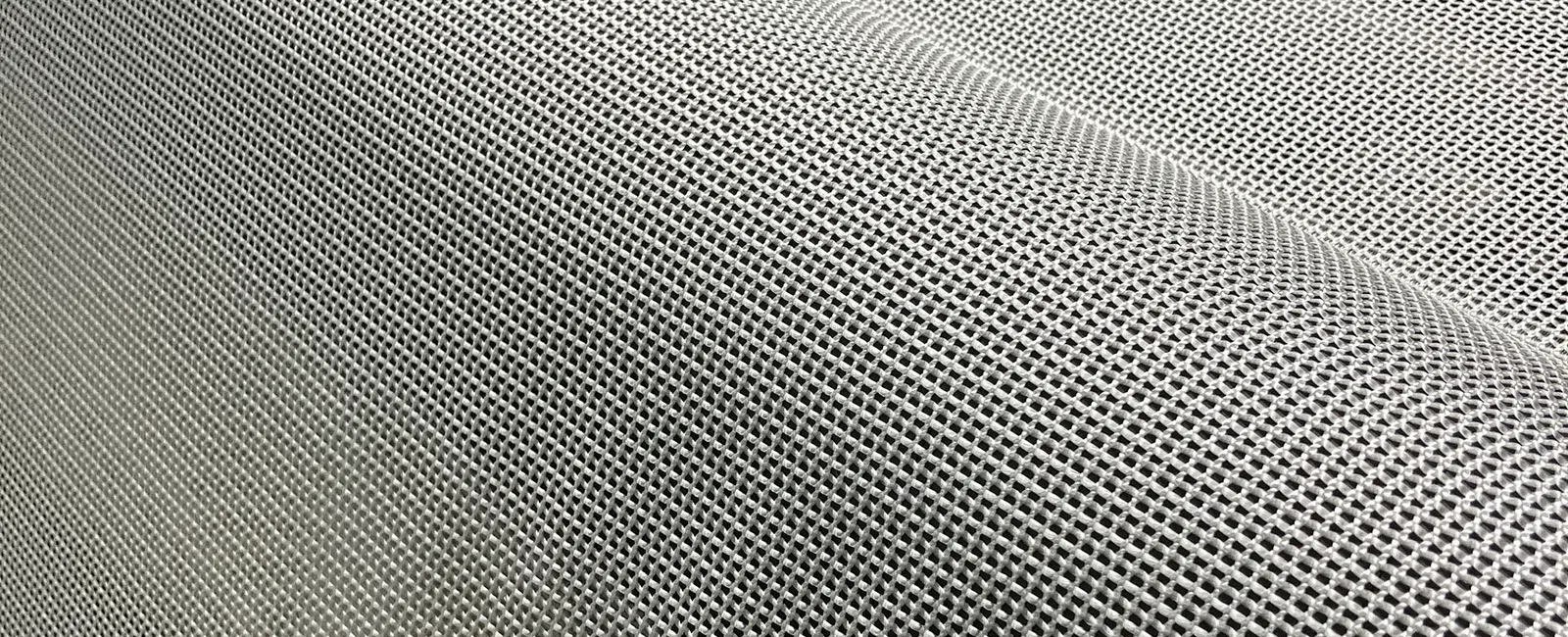
Summary: Leno weave has an open and stable construction. This weave type twists paired warp yarns around each filling pick instead of running them parallel, which locks the construction against slippage even when the fabric is mostly open space. It is useful in instances where the fabric has to let materials pass through while also remaining unmoved. Leno fabrics are used for filtration, reinforcement scrim, tire construction to mention just a few.
Key Takeaways:
- Leno weave gets its stability from a twisted warp pair, rather than packing yarns tightly. This design is why it can be open and still not distort.
- The construction trades raw tensile strength for dimensional stability under an open structure. The right specification depends on which property the application needs.
- The cost of Leno construction can be high, but is often comparable to less desirable solutions. When weighing Leno against a plain weave matching its same open area, the cost comparison can go either way.
Most weave selection starts with a closed structure and adjusts tightness to fit the specifications. Open Leno construction starts from the other direction, asking how open a fabric can be before it stops holding its shape. Once the specifications are set, the design locks the yarns in place instead of crowding them.
Why Does an Open Weave Need to Resist Slippage?
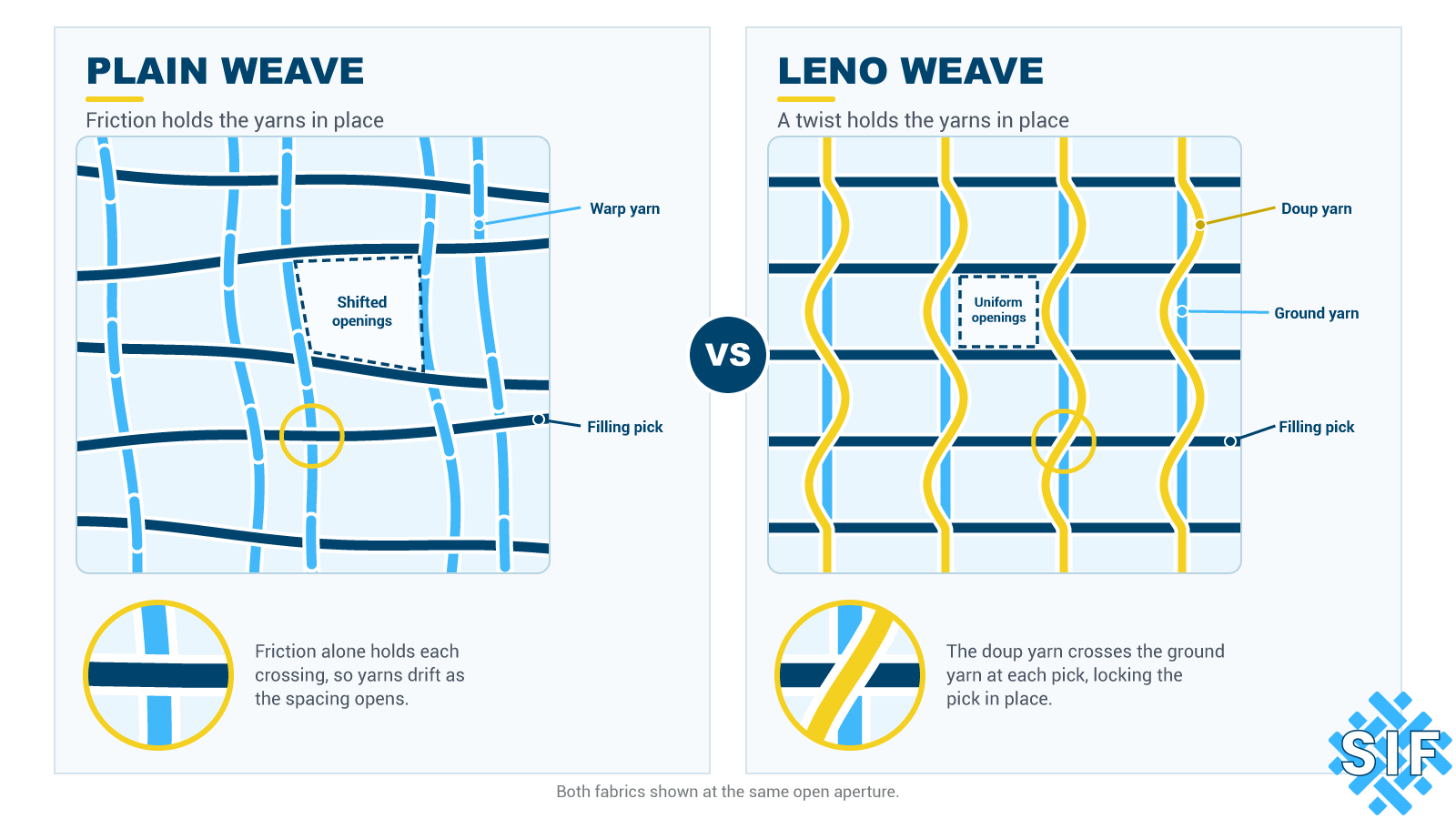
A plain weave is designed to hold its geometry through friction and yarn count. Pack the warp and fill tight enough, and the crossings hold each other in place. If you open this same weave up and space the yarns further apart to let air or liquid through, the friction holding the structure together drops away with the spacing. The yarns shift, the openings distort, and a fabric specified for a consistent aperture begins to fail.
Leno construction is the perfect solution to pair weave openness with stability without adding density to the fabric. In a leno construction, the warp yarns run in pairs. A ground yarn runs straight. It is paired with a doup yarn that crosses over its partner before every pick of filling yarn, then crosses back. This twist locks each pick in place mechanically rather than relying on tension and yarn count. The fabric can be wide open and the structure still holds.
Paired Warp Construction
The mechanism that creates a loom construction is two heald shafts and a doup wire. The ground yarn draws through the standard harness. The doup yarn draws through a second harness positioned to let it cross the ground yarn's path. On each pick, the doup crosses over, the shed opens, the filling yarn inserts, and the doup crosses back. The weft is caught between two yarns that have swapped sides around it, and it cannot slide out of that pocket without breaking the twist.
This intricate construction is why leno can cost more to weave than an equivalent open plain weave. The extra harness motion runs slower than a standard shed change, and the loom setup is not interchangeable with a plain weave job on the same beam. A buyer comparing a per-yard quote against a plain weave alternative is comparing two manufacturing set-ups.
Plain weave generally carries higher raw tensile strength than leno at a comparable yarn and count, because a tight plain weave has more points of yarn-to-yarn friction resisting the pull. Leno gives up some of that tensile ceiling in exchange for a structure that stays dimensionally stable while open. The right choice depends on which property the application requires. A load-bearing strap calls for a plain weave. A filter medium that has to hold its pore size would perform best with leno construction.
Where Does an Open, Stable Construction Outperform a Closed One?
Filtration is the clearest case. A filter medium has to let a fluid or gas pass through a controlled opening while resisting the pressure and turbulence of that flow. A plain weave open enough to hit the target permeability tends to distort under sustained flow, which changes the pore size mid-service life. A leno construction holds that aperture because the twist is doing the holding, not the pick density. Polypropylene and polyester leno geotextiles are specified this way. The aperture is sized to the soil or filtration target, and the spec only holds if the opening stays put under load.
Reinforcement scrim is the same logic applied to a composite or laminate rather than a fluid. A scrim layer adds tensile and tear resistance to a substrate without adding meaningful thickness or weight, and leno gets there at low fabric weight because the open structure uses less yarn per square yard than a comparably stable plain weave would need. Common scrim substrates share that same need for reinforcement without weight.
- Roofing underlayment
- Carpet backing
- Rubber sheet and belting
- Composite laminate layers
The application that surprises most engineers outside the tire industry is inside the tire itself. The engineering logic follows the same pattern leno delivers everywhere else. An open construction stiff enough to reinforce, without adding the bulk a tighter weave would bring to a part of the tire that flexes through every rotation.
What Should You Ask Before Specifying Leno?
The open-area number is the first thing to nail down, and it should be stated as a target with a tolerance, not a single figure, since a production lot will vary slightly around any target. Ask what happens to the application if the aperture runs at the tight end of that tolerance versus the open end. If both are acceptable, the specification has room. If only one direction is safe, say so explicitly, because a weave that is nominally correct but skewed toward the wrong side of a tolerance can still fail the application.
Fiber choice interacts with the construction more than it does in a plain weave, because the doup yarn is under more mechanical stress at every crossing than a straight-running warp end. A fiber with low abrasion resistance can wear at the crossing point before it wears anywhere else in the fabric.
Southern Industrial Fabrics runs sectional warping on site in Rossville, across multiple shifts daily. Preparing a warp in sections, with tension controlled per section rather than across the full width at once, protects the kind of yarn a leno application is most likely to specify. A buyer asking about leno should ask how the mill preps the warp as well as how the mill weaves it.
Leno is not automatically more expensive than a comparable plain weave. It is worth asking a mill to walk through rather than assuming either way. A plain weave built to match leno's stability at the same open area typically needs a tighter count, which means more yarn per square yard. Total cost weighs the slower leno weave rate against that added yarn, and for a genuinely open, low-weight specification, the yarn savings can outweigh the slower rate.
Southern Industrial Fabrics weaves leno constructions in Rossville, Georgia. Tell us the aperture, the fiber, and what the construction needs to resist. Our team will help you develop the right weave for your application.
Frequently Asked Questions (FAQ)
What is Leno weave?
Leno weave is a construction where warp yarns run in twisted pairs rather than parallel. One yarn of each pair crosses over its partner before every filling pick, then crosses back, mechanically locking the pick in place. That lock lets the fabric stay open and stable at the same time.
What is Leno weave used for?
Leno weave is specified anywhere a fabric needs a controlled open area that holds its shape under stress. Common applications include filtration media, reinforcement scrim for roofing and composite substrates, geotextile reinforcement, and tire construction, where a leno flipper reinforces the bead area without adding bulk to a part of the tire that flexes constantly.
How is leno weave different from plain weave?
Plain weave holds its shape through tight packing and yarn-to-yarn friction, which gives it higher raw tensile strength at a comparable count. Leno weave holds its shape through a mechanical twist in the warp, which lets it stay open without distorting. The tradeoff holds both directions. Plain weave wins on tensile strength, leno wins on dimensional stability at an open aperture.
Why does leno weave resist slippage better than an open plain weave?
An open plain weave depends on friction between crossing yarns to hold position, and friction drops as the yarns spread further apart. Leno weave replaces friction with a mechanical lock. The doup yarn physically crosses the ground yarn around each pick, so the pick cannot slide out of position regardless of how open the surrounding structure is.
Does leno weave cost more than plain weave?
Not automatically. Weaving leno runs slower than a standard plain weave because of the extra harness motion, which adds cost per yard of weaving time. But a plain weave built to match leno's stability at the same open area usually needs a tighter count and more yarn. For a genuinely open, low-weight specification, leno can cost less in total material even with the slower weave rate.
What fibers work in a leno construction?
Most fibers that weave in a plain construction can also weave in leno.
- Polyester
- Polypropylene
- Nylon
- Aramid
The doup yarn takes more mechanical stress at each crossing than a straight warp end, so fiber abrasion resistance matters more here than in a comparable plain weave.
Can a leno weave be too open for a filtration application?
Yes. Past a certain aperture, the twist still holds the structure together but the opening no longer captures the target particle or droplet size, so the fabric functions as a coarse screen rather than a filter medium. The lock prevents distortion. The lock does not substitute for specifying the correct aperture in the first place.
Who manufactures leno weave fabric in the United States?
Domestic capacity exists but is not widely documented. Southern Industrial Fabrics is a capable, experienced weaver of leno fabrics in the USA. A buyer sourcing domestically should confirm weaving location directly rather than assuming from a supplier's marketing language.